

Table of Contents
- What Makes USA-Made Foot Products Different
- Understanding Made in USA Product Labeling
- Foot Care Product Quality: Standards and Safety
- Foot Care Products for Nurses and Healthcare Workers
- Product Formats: Cream, Balm, Spray, and Powder
- Comparing Effectiveness: Homemade vs. Store-Bought Solutions
- How to Choose the Right Foot Care Product for Your Needs
Last Updated: October 17, 2026
What Makes USA-Made Foot Products Different
When you're on your feet all day, the quality of your foot care matters. USA-made foot products often differ from imported alternatives in how they're manufactured, regulated, and sourced. But the real question isn't just where they come from, it's whether that origin actually translates to better performance for your feet.
The distinction starts with oversight. Products manufactured in the United States operate under stricter regulatory frameworks than many imported goods. The FDA and state health departments maintain more direct authority over domestic production facilities. This doesn't automatically mean every USA-made product outperforms every imported one, but it does mean there's a clearer chain of accountability.
Ingredient sourcing is where differences often emerge. Many USA-made foot care products source their natural ingredients domestically or from verified suppliers with transparent supply chains. This visibility matters when you're dealing with sensitive skin or have concerns about what goes on your feet after a long shift. Imported products may use the same active ingredients but source them through longer supply chains where transparency can be harder to verify.
At Stomp Footcare, we focus on products designed specifically for people whose feet work hard. The choice between USA-made and imported comes down to what you're trying to solve and how much visibility you need into the product's journey.
Understanding Made in USA Product Labeling
Not all "Made in USA" claims are created equal, and that's where confusion starts. The Federal Trade Commission sets specific rules about what qualifies as USA-made, but the labeling landscape has nuances worth understanding.
A product labeled "Made in USA" must have all or virtually all of its components produced domestically, and the product must be assembled here as well. The FTC enforces these standards, but enforcement depends on consumer complaints and competitor reporting. This means some products claiming USA origin may not meet the strictest interpretation, while others exceed it significantly.
The distinction between "Made in USA," "Assembled in USA," and "Product of USA" matters. "Assembled in USA" means the final product came together domestically but components may be imported. "Product of USA" indicates all significant processing occurred here. For foot care products, this distinction affects both quality control and ingredient sourcing.
Look for documentation when making your choice. Reputable USA-made foot care manufacturers can point to specific production facilities, ingredient sourcing records, and quality certifications. If a company can't explain where their product was made or won't name their facility, that's a red flag regardless of their labeling claims.
Foot Care Product Quality: Standards and Safety
Quality in foot care products hinges on three factors: ingredient integrity, manufacturing standards, and performance consistency. USA-made products benefit from stricter facility inspections and more rigorous documentation requirements, but imported products can meet high standards too, the difference is in how easy it is to verify compliance.
Manufacturing standards in the United States are set by the FDA for over-the-counter products and enforced through facility inspections. Domestic manufacturers must maintain detailed records of their production processes, ingredient sourcing, and quality testing. This creates a paper trail that regulators can follow. Imported products must also meet FDA standards for sale in the U.S., but verification happens at the border and through periodic inspections of foreign facilities, a less consistent oversight model.
Ingredient Sourcing and Transparency
Where your foot cream's ingredients come from matters more than many people realize. USA-made products often source key ingredients like shea butter, tea tree oil, or urea domestically or from verified international suppliers with documented quality standards. This traceability reduces the risk of counterfeit or substandard ingredients entering your product.
Imported foot care products may use identical active ingredients but source them through longer supply chains. A foot balm imported from another country might contain excellent ingredients, but verifying their origin and quality requires more detective work. Reputable importers maintain this documentation, but you'll need to ask for it specifically.
Transparency is your best tool here. The best foot care products, whether USA-made or imported, clearly list their ingredients and can explain where each one comes from. If a product won't disclose its sourcing, that's a signal to keep looking.
Natural vs. Synthetic Ingredients
The natural-versus-synthetic debate in foot care products often oversimplifies the real issue: does the ingredient work for your specific foot concern?
Natural ingredients like tea tree oil, eucalyptus, and peppermint have long track records in foot care. They address dryness, odor, and general foot comfort. Many people prefer them because they feel safer and align with their values. USA-made products often emphasize natural ingredients, partly because domestic sourcing makes this easier to document and verify.
Synthetic ingredients like urea, salicylic acid, and certain preservatives are engineered for specific purposes. Urea penetrates dry, rough skin more effectively than many natural moisturizers. Salicylic acid targets calluses and dead skin directly. These aren't inferior to natural options, they're different tools for different problems.
The best foot care product uses whichever ingredient actually solves your problem. For dry heels, a USA-made balm with natural oils might work beautifully. For thick calluses, you might need the targeted action of a synthetic exfoliant. The origin matters less than the match between the product's active ingredient and your foot concern.
Foot Care Products for Nurses and Healthcare Workers
Healthcare workers face unique foot challenges. You're standing 10, 12, sometimes 14 hours a day. Your feet swell, they ache, the skin cracks, and moisture becomes both a problem and a necessity. The foot care products you choose need to address this specific reality.
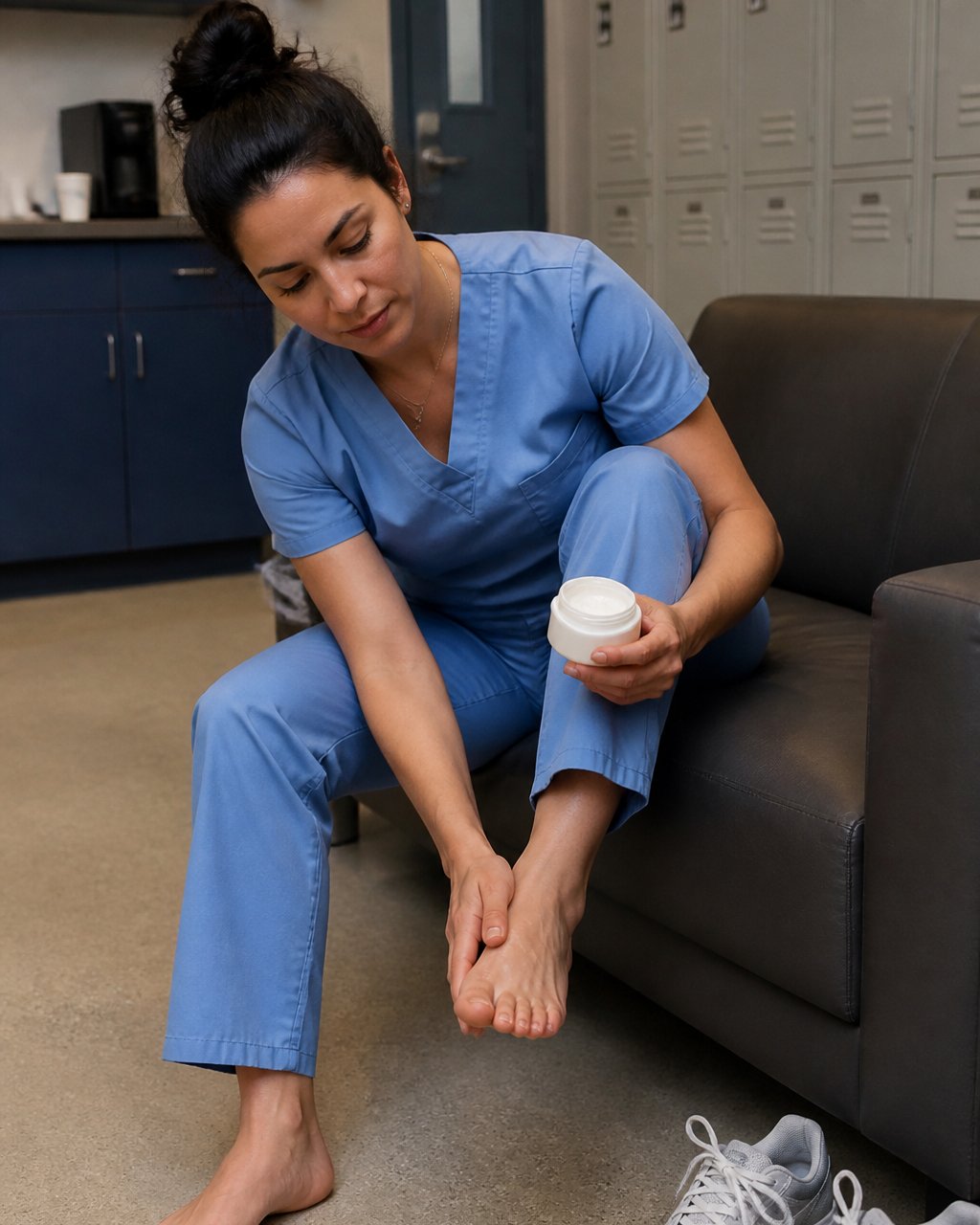
Nurses and healthcare workers need foot products that work fast and last through a shift. A foot cream that requires 20 minutes to absorb isn't practical when you have 10 minutes between patients. Balms and thicker formulations tend to perform better in these environments because they stay on your skin longer and provide extended relief.
USA-made foot care products designed for healthcare workers often build in this practical understanding. They're formulated for quick absorption, long-lasting moisture retention, and the specific combination of concerns, dryness, odor, fatigue, that come with the job. The advantage isn't inherent to USA manufacturing; it's that domestic manufacturers can more easily gather feedback from healthcare professionals and adjust formulations accordingly.
Look for products with moisture-wicking properties if sweat and excess moisture are concerns. Some USA-made balms include ingredients that manage both dryness and perspiration, addressing the paradox many healthcare workers face: feet that are simultaneously dry and sweaty.
Product Formats: Cream, Balm, Spray, and Powder
Foot care products come in four main formats, and each has a specific purpose. Understanding the differences helps you choose what actually works for your situation rather than what sounds appealing.
Creams absorb quickly and work well for daily moisturizing. They're lighter than balms, making them suitable for morning application before work. Creams suit people who need fast absorption and don't want residue on socks or shoes.
Balms are thicker, stay on skin longer, and provide deeper moisture. They're ideal for nighttime application or for people with severely dry, cracked heels. Balms take longer to absorb, which means they remain active on your skin for hours. If you're a healthcare worker with 12-hour shifts, a balm applied before work provides sustained relief that a cream might not.
Sprays address odor and moisture control without adding thickness to skin. They're convenient for midday application at work and dry quickly. Sprays work best for excess moisture and odor prevention rather than for treating dryness.
Powders absorb excess moisture and reduce friction. They're practical for people whose feet sweat heavily or who deal with moisture-related issues. Powders work alongside other products, apply a balm at night, then use powder during the day for moisture management.
The best choice depends on your specific foot concern and your lifestyle. Someone dealing with cracked heels benefits from a balm. Someone managing odor and sweat during a long shift benefits from a spray or powder. Many people use multiple formats throughout the day.
Comparing Effectiveness: Homemade vs. Store-Bought Solutions
The homemade-versus-store-bought question comes down to consistency, ingredient quality, and time investment.
Homemade foot care solutions, mixing coconut oil with essential oils, creating a DIY balm with beeswax, offer complete control over ingredients. You know exactly what's going on your skin. The downside is inconsistency. If you're using them occasionally, this works fine. If you need reliable relief every single day, consistency matters.
Store-bought products, particularly USA-made ones, offer standardized formulations. Every container delivers the same texture, the same ingredient ratios, and the same expected results. This consistency is especially valuable when you're managing a foot concern that requires daily attention. A nurse dealing with cracked heels needs a product that performs the same way on day one and day thirty.
The cost equation also shifts when you factor in time. Making homemade foot balm takes an hour or two. If you're already working 12-hour shifts, that time might be better spent resting your feet than making products for them.
Aspect |
Homemade |
Store-Bought (USA-Made) |
|---|---|---|
Ingredient Control |
Complete |
Verified sourcing |
Consistency |
Varies batch to batch |
Standardized |
Time Investment |
1-2 hours per batch |
None (ready to use) |
Shelf Stability |
2-6 weeks typically |
12+ months |
Cost Per Use |
Lower upfront, higher time cost |
Higher upfront, lower time cost |
Quality Testing |
None |
Manufacturer tested |
How to Choose the Right Foot Care Product for Your Needs
Start by identifying your specific foot concern. Are you dealing with dryness? Odor? Calluses? Swelling? Excess moisture? The right product addresses your actual problem, not a general category.
Next, consider your lifestyle. If you're on your feet 10+ hours daily, you need a product that lasts. A lightweight cream might not cut it; you probably need a balm or a combination approach with spray or powder. If you have occasional foot discomfort, a simpler product works fine.
Check the ingredient list against your sensitivities. If you react to certain preservatives or have sensitive skin, USA-made products often provide clearer sourcing documentation. You can call the manufacturer and ask specific questions about ingredient origin and processing.
Look for third-party certifications that matter to you. If cruelty-free matters, Stomp Footcare carries PETA-certified products. If sustainability is a priority, ask about packaging and ingredient sourcing.
