

Table of Contents
- Why 12-Hour Shifts Demand More Than Willpower
- Quick Comparison: Best Foot Care Products for Nurses
- 1. Energizing Foot Cream: Fast Relief for Tired, Aching Feet
- 2. Hydrating Foot Cream: Repair Dry, Cracked Skin After Shifts
- 3. Lotion to Powder Deodorizer: Stay Dry Through Long Hours
- 4. Mineral Foot Soak: Post-Shift Recovery for Swollen Feet
- 5. Intensive Callus Remover: Smooth Rough Patches and Heels
- 6. Revitalizing Foot Scrub: Exfoliate and Refresh Tired Soles
- How to Prevent Foot Swelling for Nurses
- Choosing the Right Shoe Material
- What Most Guides Miss
- Frequently Asked Questions
Last Updated: September 11, 2026
Why 12-Hour Shifts Demand More Than Willpower
Anyone who has worked a 12-hour shift knows the math: roughly 10 to 12 of those hours are spent upright, and much of it on hard flooring. According to the Bureau of Labor Statistics occupational outlook for registered nurses, nursing remains one of the largest and fastest-growing occupations in the country, which means millions of people are logging these hours every week. That kind of repetitive load produces foot fatigue, edema, calluses, and cracked heels long before willpower gives out. This guide from Stomp Footcare covers the best foot care products for nurses, organized as a practical kit that addresses each problem in the order a shift creates it. Below, we'll show you exactly how to build that kit and what each item actually does.
The core idea: foot discomfort on shift work is a mechanical and skin-barrier problem, not a toughness problem. Compression manages swelling, cushioning absorbs impact, and topical products repair the skin barrier between shifts.
Quick Comparison: Best Foot Care Products for Nurses
Here is the full kit at a glance, with pricing and the problem each item solves.
Product |
Price |
Primary Job |
Best Used |
|---|---|---|---|
$11.99 |
Cools and relieves aching feet |
Mid-shift or right after |
|
Hydrating Foot Cream |
$9.99 |
Repairs dry, cracked skin |
Nightly before bed |
Lotion to Powder Deodorizer |
$9.99 |
Controls sweat and odor |
Before every shift |
Mineral Foot Soak |
$14.99 |
Reduces swelling, softens skin |
2-3 times per week |
Intensive Callus Remover |
$9.99 |
Smooths rough patches and heels |
2-3 times per week |
Revitalizing Foot Scrub |
$9.99 |
Exfoliates and boosts circulation |
Once weekly |
The kit totals under $70.

1. Energizing Foot Cream: Fast Relief for Tired, Aching Feet
The first item in any set of foot care products for shift work is the one you reach for when your feet are actively screaming. Stomp Footcare's Energizing Foot Cream at $11.99 uses menthol to cool on contact, while urea and aloe vera condition the skin underneath.
A common mistake is waiting until you get home. A thin layer during a break keeps the ache from compounding through the back half of the shift.
2. Hydrating Foot Cream: Repair Dry, Cracked Skin After Shifts
Skin repair is the second layer, and it belongs to the nighttime routine. The Hydrating Foot Cream at $9.99 is a lightweight, non-greasy formula built around jojoba oil, aloe vera, vitamin B5, and urea, which draws moisture into the skin and softens thickened heel tissue.

Apply it after your shower while skin is still damp, then put on cotton socks. This traps moisture and lets the urea work overnight, many nurses find this habit helps with heel crack repair.
3. Lotion to Powder Deodorizer: Stay Dry Through Long Hours
Moisture is the root of most foot odor and blistering. The Lotion to Powder Deodorizer at $9.99 goes on as a cream and dries to a soft, powdery finish. Tapioca starch and zinc oxide absorb sweat, while moisturizers prevent chafing from damp skin rubbing against a sock all day.

Apply it before your shift, not after, on clean, dry feet with moisture-wicking socks rather than cotton.
4. Mineral Foot Soak: Post-Shift Recovery for Swollen Feet
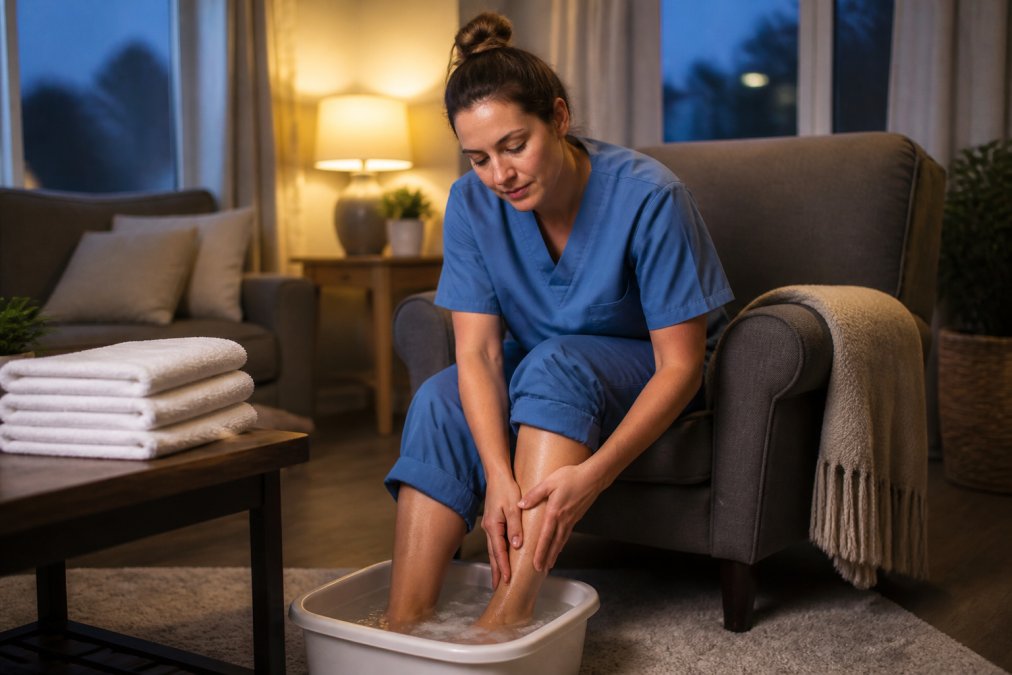
Post-shift recovery is where most foot care routines fall apart. The Mineral Foot Soak at $14.99 combines dead sea salt, tea tree oil, peppermint, and eucalyptus to exfoliate, soften, cool, and soothe tired feet.
Soak for 10 to 15 minutes, two or three times a week, with your feet elevated on the edge of the tub. Elevation is the part people skip, and it is what actually addresses edema management.
5. Intensive Callus Remover: Smooth Rough Patches and Heels
Calluses are the body's response to repeated pressure, and nurses develop them on the heels and ball of the foot. The Intensive Callus Remover at $9.99 pairs salicylic acid, which loosens dead skin cells, with urea and aloe vera to hydrate what is underneath.
Use it two or three times a week on dry, clean skin, and never immediately after soaking. Soaked skin is softer and may be more susceptible to over-treatment, which could lead to irritation.
6. Revitalizing Foot Scrub: Exfoliate and Refresh Tired Soles
The last piece of the kit handles gentle exfoliation and circulation. The Revitalizing Foot Scrub at $9.99 is a pumice-based scrub with aloe vera, vitamin B5, and vitamin E that scrubs away rough, dry skin and stimulates blood flow after a long day on your feet.
Once a week is enough. More frequent scrubbing may strip the skin barrier, potentially leaving skin more prone to cracking.
How to Prevent Foot Swelling for Nurses
Swelling after a 12-hour shift is often related to fluid mechanics. When you stand for hours on a hard floor, the calf muscle pump that normally pushes venous blood back toward the heart gets less help from the stride, and hydrostatic pressure pulls fluid into the interstitial space around the ankle and forefoot.
Compression is the first lever, and the pressure rating matters more than the brand. guidance on compression stockings from the Cleveland Clinic explains that graduated compression applies the most pressure at the ankle and less as it moves up the calf, which helps the vein walls push fluid upward instead of letting it pool. For shift work on hard flooring, a 15-20 mmHg graduated sock is the common starting point (my.clevelandclinic.org). Two practical rules: put them on before you get out of bed, when overnight swelling has already drained, and check the fit at the calf, a sock that bunches behind the knee creates a tourniquet effect that makes swelling worse, not better.
Elevation works, but only above heart level. Feet on an ottoman for ten minutes does very little. The position that may help move fluid is legs up a wall or propped on pillows so the ankles sit above heart level. Ten to fifteen minutes is often suggested; the effect is believed to come from gravity reversing the pressure gradient.
Footwear geometry is the third lever. Three features matter for swelling specifically:
- A wide toe box. Narrow shoes compress the forefoot, and compressed tissue holds fluid. Look for a shoe where you can splay your toes fully without the upper pressing on the fifth toe.
- A removable insole. This is not about comfort, it is about the ability to swap in an orthotic later without buying new shoes. A removable insole also lets you air out and replace the footbed, which can contribute to odor and moisture.
- A midsole with real rebound. The foam under your foot compresses with every step and recovers between steps. EVA foam may lose its rebound within a few months of daily 12-hour wear. Rotating two pairs can be beneficial, as the foam may need time to return to shape, and a single pair worn daily might not fully recover.
Material science, briefly, because it changes what you buy. EVA foam is light, cheap, and cushioning when new, but it packs out. Gel inserts add pressure relief under the heel and forefoot but do not replace midsole structure. Polyurethane midsoles are denser and hold their shape longer than EVA. Carbon plates are stiff and designed for a forward running stride, they may not be an ideal fit for the standing-heavy movement of a hospital floor. Many nurses find a flexible forefoot and a stable heel to be more beneficial.
Floor surface should drive the choice. Tile and linoleum can transmit impact, so cushioning may be particularly important. Concrete, common in older facilities, is harder still and may benefit from a thicker midsole. Carpeted units are generally more forgiving, and a nurse rotating between a carpeted clinic and a tile med-surg floor might consider two different shoes rather than one compromise pair.
- Compression socks on before your feet hit the floor
- Shoes with a wide toe box and removable insole
- Two pairs rotated, not one pair worn daily
- Feet elevated above heart level 10-15 minutes after every shift
- Midsole checked for packing every 3-4 months of daily wear
Choosing the Right Shoe Material
Most guides tell you to look for "breathable mesh" and "good cushioning" and stop there. The midsole material, upper construction, and how they interact with the floor can be important factors in a shoe's performance during a 12-hour shift.
The midsole is the part that matters most, and the part shoppers ignore. It is the layer between your foot and the outsole, where cushioning and rebound live. Three materials dominate:
- EVA foam is the default: light, cheap, and comfortable when new, but it compresses permanently under repeated load. A nurse wearing one EVA pair for 12-hour shifts may notice it flatten within a few months. EVA can be effective if you rotate pairs and replace them on schedule.
- Polyurethane is denser and heavier than EVA but holds its shape far longer. Shoes built on polyurethane midsoles cost more up front and last longer, which is why some nurses treat them as the better value over a year.
- Gel inserts are a layer, not a midsole. They relieve pressure under the heel and ball of the foot, but they do not fix a packed-out midsole underneath.
Carbon plates are the wrong tool for this job. They are stiff and designed to return energy during a forward running stride. On a hospital floor, standing, pivoting, short lateral steps, a stiff plate reduces forefoot flex and can increase pressure at the ball of the foot. Unless a podiatrist recommends one, most nurses do better with a flexible forefoot and a stable, cushioned heel.
Match the shoe to the floor, not the marketing. Tile and linoleum can transmit impact, so a thicker, softer midsole may be particularly beneficial. Concrete, common in older buildings, is harder still. Carpeted units are generally more forgiving, and a nurse splitting time between a carpeted clinic and a tile med-surg floor might genuinely benefit from two different shoes.
The upper controls heat and moisture, which drive odor and blisters. Breathable mesh can move heat and sweat away more effectively than solid leather, and a moisture-wicking lining helps keep damp skin from rubbing against the sock. A non-slip outsole is important, as hospital flooring can be wet, and a slip could lead to injury. A deep heel cup can help stabilize the ankle and may reduce small corrective movements that can contribute to arch and heel pain.
When to stop shopping and see a podiatrist. Pain that is sharp, persistent, or worst with the first steps out of bed may indicate conditions like plantar fasciitis rather than solely a shoe problem. Bunions, persistent edema that does not resolve overnight, and numbness or tingling in the toes are also signals that a product change alone may not resolve the issue. An over-the-counter orthotic with metatarsal support can sometimes help with flat feet or high arches, but a structural issue often benefits from a clinical assessment.
What Most Guides Miss
Two things can be important for an effective routine. First, timing: products applied at the wrong moment may be less effective. Second, consistency across the whole kit rather than relying on one hero product.
Stomp Footcare's full range is PETA certified and made in the USA, which matters if you are stocking these for a wellness boutique or a staff wellness program and need documentation for your customers.
Frequently Asked Questions
How do nurses take care of their feet during 12-hour shifts?
Nurses should prioritize supportive footwear with arch support and cushioning, wear compression socks to improve circulation, and take short breaks to stretch. Using a hydrating foot cream before shifts and a mineral soak after can help manage foot fatigue. Keeping feet dry with a deodorizing powder or spray also prevents moisture buildup and odor.
What should nurses look for in foot care products?
Look for products with urea for hydration, salicylic acid for callus removal, and moisture-wicking ingredients like tapioca starch for dryness. Compression socks should offer graduated pressure, and insoles should provide metatarsal support and a deep heel cup. Avoid products with harsh fragrances if you have sensitive skin.
How can nurses manage foot swelling effectively?
Elevate your feet during breaks, wear compression socks, and stay hydrated. After shifts, soak feet in a mineral soak with sea salt and peppermint to reduce swelling and soothe aches. Gentle stretching and avoiding prolonged standing without support also help. If swelling persists, consult a healthcare professional.
What are the best foot care products for preventing blisters and calluses?
Use an intensive callus remover with salicylic acid and urea to soften rough patches, and exfoliate regularly with a foot scrub. Choose moisture-wicking socks and properly fitted shoes to reduce friction. Applying a hydrating foot cream daily keeps skin supple and less prone to cracking.
Do podiatrists recommend specific foot creams for healthcare workers?
Podiatrists often recommend creams containing urea, aloe vera, and vitamin B5 for their hydrating and skin-repairing properties. Look for non-greasy, fast-absorbing formulas that can be applied before or after shifts. Ingredients like menthol can provide cooling relief for tired feet.
