

Table of Contents
- Why Your Feet Hurt After Standing All Day
- Immediate Relief: Stretches for Foot Pain
- How to Reduce Foot Swelling After Work
- The Best Shoes for Standing All Day
- Your Micro-Break Protocol for Long Shifts
- Home Care Routine: Massage, Soaks, and Recovery Tools
- When to See a Podiatrist
- Final Word on Standing All Day Foot Care
- Frequently Asked Questions
Last Updated: September 6, 2026
If you spend eight hours standing on your feet all day, you know exactly how your feet feel by the end of the shift: throbbing, swollen, and heavy. Finding out how to relieve foot pain from standing all day isn't just about comfort, it's about protecting your long-term mobility. The good news is that the most effective relief combines immediate stretches with smart footwear choices and a few recovery habits you can start tonight.
At Stomp Footcare, we understand the challenges faced by people who work on their feet. Most foot pain from prolonged standing stems from blood pooling in the lower legs and repetitive strain on the plantar fascia (peer-reviewed research). Below, we'll walk you through a practical, step-by-step system for relief, including the stretches, footwear, and recovery tools that actually work.
Why Your Feet Hurt After Standing All Day
Foot pain from standing all day is usually a mix of poor circulation, muscle fatigue, and repeated impact on hard surfaces. When you stand still, your calf muscles don't pump blood back to your heart as effectively, which leads to swelling and that heavy, achy feeling. Meanwhile, the plantar fascia, the thick band of tissue along the bottom of your foot, absorbs constant tension, which can flare into conditions like plantar fasciitis or metatarsalgia.
Ergonomics play a larger role than most people realize. Hard concrete and tile offer zero impact absorption, forcing your joints and soft tissues to take the full load. Over time, this repetitive strain contributes to tendon strain and chronic pain, especially if your shoes lack proper arch support or cushioning.
Immediate Relief: Stretches for Foot Pain
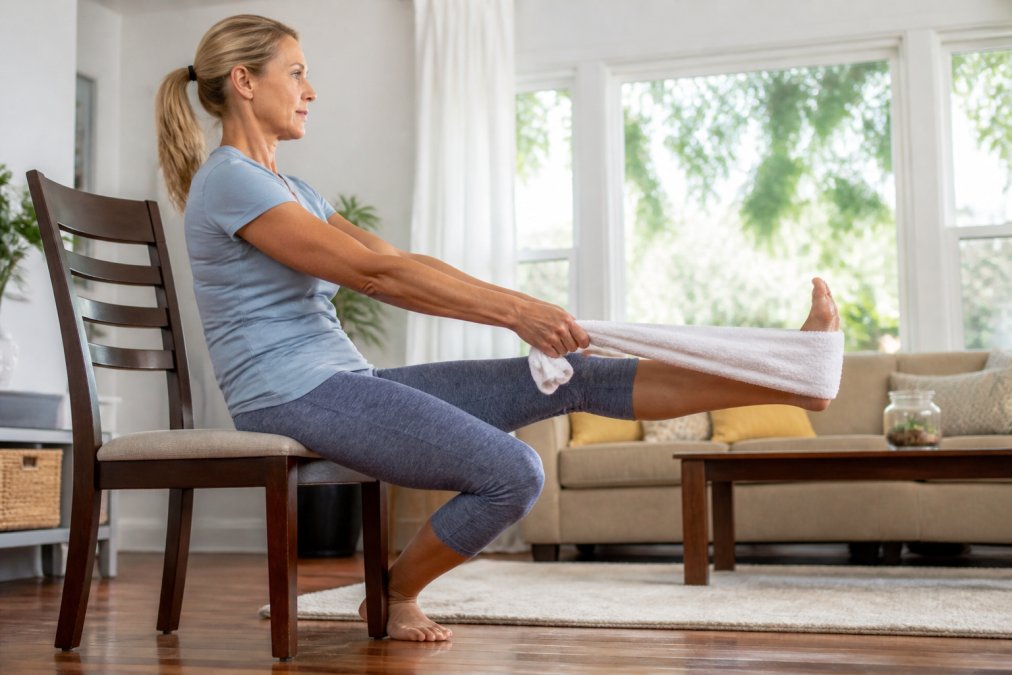
The fastest way to relieve foot pain after a long shift is to target the calf and the arch, since tension in the calf directly pulls on the plantar fascia. Start with a seated calf stretch: sit on a chair, extend one leg, and loop a towel around the ball of your foot. Gently pull your toes back toward you and hold for 30 seconds. Repeat three times per leg.
Next, try heel raises to improve ankle mobility and circulation. Stand with your feet hip-width apart, rise onto your toes, and slowly lower your heels. Perform 15 repetitions. For deeper arch relief, roll the bottom of your foot over a frozen water bottle for five minutes; this combines a myofascial release with cold therapy to reduce inflammation.
How to Reduce Foot Swelling After Work
Swelling happens because gravity pulls fluid into your lower legs while you stand. To counter this, elevate your feet above heart level for 15 to 20 minutes after work; this simple habit uses gravity to drain fluid back toward your core. Compression socks are another effective tool because they gently squeeze the lower leg, supporting circulation and preventing fluid from pooling.
A Stomp Footcare Mineral Soak can also provide meaningful relief. Warm water helps dilate blood vessels, while the magnesium in the salts may ease muscle fatigue and tension. Soak for 15 minutes, then follow with a quick foot massage using upward strokes toward the knee to encourage lymphatic drainage. If swelling is severe or persists overnight, mention it to a podiatrist, as it can signal circulation problems that need professional attention.
The Best Shoes for Standing All Day
The best shoes for standing all day share three non-negotiable traits: firm arch support, thick cushioning, and a wide toe box. Arch support distributes your weight evenly across the foot, reducing pressure on the metatarsal heads, while cushioning absorbs the shock of each step on hard floors. Look for shoes with a slight heel-to-toe drop (8-12 mm), which takes tension off the Achilles tendon and calf.
But choosing the right shoe is only half the battle. The other half is knowing when to replace it. Most workers keep their shoes far too long, and a worn-out midsole is a hidden cause of recurring foot pain. Here is a practical rule of thumb: if you work on your feet full-time, replace your work shoes every 300-500 hours of wear. For a 40-hour work week, that means every 8-12 weeks. For part-time workers, check every six months.
Do not rely on the calendar alone. Inspect your shoes monthly using the "twist and press" test. Hold the shoe at both ends and twist it. If the midsole twists easily like a wet towel, the structural support is gone. Next, press your thumb into the heel cushion. If it does not spring back within a second, the foam is compressed and will no longer absorb impact.
Also, examine the outsole wear pattern. Uneven wear on the outer heel or inner forefoot indicates a gait imbalance that may require a stability shoe or custom orthotic. If you see the tread worn down to the midsole in any area, it is time to shop.
|
Shoe Feature |
Why It Matters |
What to Look For |
Replacement Signal |
|---|---|---|---|
|
Arch Support |
Distributes weight evenly |
Firm midfoot contour that does not collapse |
Twisting easily indicates broken-down support |
|
Cushioning |
Absorbs impact on hard floors |
Thick foam or gel heel pad |
Thumb press leaves a permanent dent |
|
Toe Box |
Prevents crowding and blisters |
Room to wiggle toes |
Visible wear at the pinky toe seam |
|
Heel Drop |
Reduces calf and Achilles strain |
8-12 mm drop |
Heel counter feels loose or tilts |
When you shop for replacements, test shoes at the end of the day when your feet are naturally slightly swollen. Wear the same socks you wear to work. Walk on a hard surface in the store, not just carpet. And rotate between two pairs if your budget allows; alternating shoes gives the foam 24 hours to decompress, which extends the life of both pairs.
For workers with flat feet or high arches, a custom orthotic from a podiatrist is worth the investment. Over-the-counter insoles provide generic support, but a custom device corrects your specific biomechanics. Most practitioners recommend trying a firm over-the-counter arch support first; if your pain persists after two weeks, then pursue a custom evaluation.
Your Micro-Break Protocol for Long Shifts
Taking short, frequent breaks is one of the most underused strategies for foot pain relief. A micro-break protocol involves moving for one to two minutes every hour, which restarts the calf muscle pump and resets your posture. Set a timer on your phone or watch to remind you, since it is easy to lose track of time during a busy shift.
During each break, perform a simple circuit: march in place for 30 seconds, do 10 heel raises, and rotate each ankle through its full range of motion. If you can step away from your station, a short walk of 50 to 100 steps is even better. These small movements prevent muscle fatigue from settling in and keep blood moving through your lower legs.
Home Care Routine: Massage, Soaks, and Recovery Tools
A consistent evening routine separates occasional relief from lasting improvement. But the right routine depends on the surface you stood on all day. Concrete, tile, carpet, and anti-fatigue mats each stress your feet differently, and your recovery should match that stress.
If you stood on concrete or tile: Your feet absorbed high-impact shock with zero give. Focus on cold therapy first. Fill a shallow basin with cold water (50-60°F) and ice cubes, and soak your feet for 10 minutes (peer-reviewed research). This constricts blood vessels and reduces the micro-inflammation caused by hard-surface impact. Follow with a 5-minute self-massage using a frozen water bottle rolled under your arch. The combination of cold and pressure releases the plantar fascia while numbing any sharp pain.
If you stood on carpet or a padded mat: Your feet did not absorb as much shock, but your calves and Achilles tendon worked harder to stabilize you on the softer, less predictable surface. Skip the ice. Instead, use a warm Stomp Footcare Mineral Soak for 15 minutes to relax the calf muscles. Then perform a deep calf release: kneel on one knee, place the other foot flat in front, and gently lean forward to stretch the rear calf for 45 seconds per side. Finish with a foam roller on your calves, not your feet, since the tension is concentrated higher up the kinetic chain.
If you stood on an anti-fatigue mat: These mats reduce impact but create subtle instability that recruits smaller stabilizing muscles in your feet and ankles. Your feet may feel tired in unusual places, like the outside edge or the ball near the pinky toe. Use a massage stick or lacrosse ball to work along the entire outer edge of the foot, from heel to pinky toe. Then do 15 single-leg balance exercises (stand on one foot for 30 seconds, eyes open, then closed) to retrain those stabilizers.
Regardless of surface, finish your routine with a 10-minute elevation period. Lie on your back and prop your feet against a wall at a 90-degree angle. This is not just about draining fluid; it also signals your nervous system to shift out of "standing mode." Many workers report that this position, combined with slow breathing for 10 minutes, reduces the systemic fatigue that makes them feel drained after a shift.
For callus management, do not aggressively file or cut thick skin. Instead, apply Stomp Footcare Callus Remover, a salicylic acid and urea-based product. Urea breaks down the protein bonds in dead skin and keeps the area flexible. After two weeks of nightly application, calluses will soften. Avoid razors or aggressive files, which create micro-tears that can become infected.
When to See a Podiatrist
While most standing-related foot pain responds to home care, certain symptoms warrant a professional evaluation. See a podiatrist if you experience sharp heel pain with your first steps in the morning, numbness or tingling in the toes, or swelling that does not subside with elevation. These can be signs of plantar fasciitis, nerve compression, or stress fractures that require targeted treatment.
Final Word on Standing All Day Foot Care
Learning how to relieve foot pain from standing all day comes down to a few daily habits: stretch your calves, move hourly, and support your arches with the right footwear. The routine outlined here addresses the root causes of foot pain, circulation, strain, and poor support, so you can finish your shift without dreading the walk to the car.
At Stomp Footcare, we build our products for people who spend their days on their feet, whether on a factory floor or a hiking trail. Our PETA-certified, cruelty-free products are made in the USA to support your foot health routine.
Frequently Asked Questions
Can barely walk after standing all day, what should I do?
If you can barely walk, start with immediate offloading. Sit down, elevate your feet above heart level for 15 minutes, and apply a cold compress to reduce inflammation. Perform gentle calf stretches only if pain allows. If sharp pain persists or you cannot bear weight, see a podiatrist to rule out plantar fasciitis or a stress fracture.
Is it normal for my feet to hurt after standing for 4 hours?
Mild fatigue after 4 hours on your feet is common, especially if you're not used to it. But sharp, burning, or persistent pain signals a problem with your biomechanics or footwear. Check if your shoes have adequate arch support and cushioning. If pain becomes a daily occurrence, consider custom insoles and consult a podiatrist.
How can I stand for 10 hours without pain?
Standing for 10 hours without pain requires a proactive strategy. Wear the best shoes for standing all day with proper arch support. Use an anti-fatigue mat on hard surfaces. Take micro-breaks every hour: sit for 2 minutes, do 10 heel raises, and roll your foot on a frozen water bottle. Compression socks can also improve circulation and reduce muscle fatigue.
How do I stop my legs from hurting when I stand all day?
Leg pain from standing often stems from blood pooling and muscle fatigue. To counter this, shift your weight frequently and walk a few steps every 30 minutes. At home, elevate your legs for 20 minutes to help circulation. Stretches for foot pain and the calves, like wall push-ups, release tension that radiates up the leg. Massage legs with Stomp Footcare Energizing Cream. If swelling is severe, see a doctor to rule out venous issues.
