

Table of Contents
- Why Most Foot Lotions Fail Dry Skin
- Best Foot Lotion for Dry Skin: Stomp Hydrating Foot Cream
- Best Ingredients for Dry Foot Skin: What Actually Works
- How to Treat Cracked Heels Fast
- Daily Foot Care Routine for Hydration
- Frequently Asked Questions
Last Updated: September 9, 2026
Why Most Foot Lotions Fail Dry Skin
Most foot lotions fail because they only add moisture without addressing why feet become dry: pressure, friction, and exposure strip natural oils, creating thickened skin a body lotion can't penetrate. A true foot lotion for dry skin must soften the hardened layer, deliver deep hydration, and lock it in.
Best Foot Lotion for Dry Skin: Stomp Hydrating Foot Cream
Stomp Hydrating Foot Cream combines immediate softening with long-term barrier repair. This lightweight, non-greasy formula hydrates, protects, and nourishes.

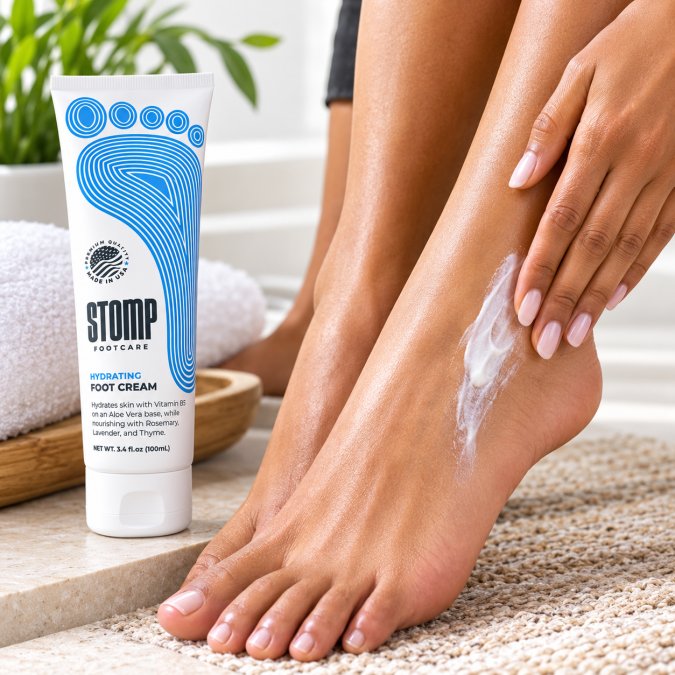
Its active ingredients work synergistically: urea draws in moisture while exfoliating dead cells; jojoba oil and aloe vera calm irritation; vitamin B5 repairs fissures; and hyaluronic acid adds lasting hydration.
It absorbs quickly with no greasy residue, so you can apply it before socks or bed. Apply twice daily, focusing on heels and balls of the feet.
Best Ingredients for Dry Foot Skin: What Actually Works
The best ingredients fall into three categories. Humectants (urea, hyaluronic acid, glycerin) draw water to the surface; emollients (jojoba oil, shea butter, ceramides) fill gaps between cells to smooth rough texture.
Occlusives like petroleum jelly form a barrier to prevent moisture loss, but relying on them heavily can trap heat. Effective formulations balance all three types to seal benefits without feeling heavy.
Ingredient Category |
Function |
Examples |
Best For |
|---|---|---|---|
Humectants |
Draw moisture into skin |
Urea, hyaluronic acid, glycerin |
Deep hydration, softening calluses |
Emollients |
Smooth and fill skin gaps |
Jojoba oil, ceramides, shea butter |
Improving texture, reducing flaking |
Occlusives |
Seal in moisture |
Petroleum jelly, lanolin |
Preventing moisture loss, overnight treatment |
Keratolytics |
Break down dead skin |
Salicylic acid, lactic acid |
Treating calluses, cracked heels, thick skin |
Salicylic acid, a keratolytic, dissolves bonds holding dead skin cells together, making it key for persistent calluses. Combined with urea in Stomp Intensive Callus Remover, it smooths thick skin.

Fragrance-free and dye-free formulas are essential for anyone with sensitive skin or conditions like eczema, as synthetic fragrances are among the most common irritants in skincare products. The American Podiatric Medical Association guidelines on foot care recommend looking for products with urea or ammonium lactate for dry skin, as these ingredients have the strongest evidence for softening thickened skin. A clinical review published in the Journal of the American Academy of Dermatology found that urea-based moisturizers significantly improved skin hydration and barrier function in patients with xerosis, or abnormally dry skin, compared to placebo.
For those seeking a complete foot care routine, pairing a daily hydrating cream with a weekly exfoliating treatment can deliver effective results. Use Stomp Footcare Hydrating Cream every morning and night to maintain moisture levels and support skin barrier repair, then incorporate a salicylic acid-based callus remover two to three times per week to address stubborn rough patches. A guide from the American Academy of Dermatology on treating cracked heels emphasizes that consistency matters more than intensity, using a gentle product daily will outperform aggressive treatments applied sporadically, as the skin needs regular reinforcement to maintain its repaired state.
How to Treat Cracked Heels Fast
Cracked heels, or fissures, occur when thick, inflexible skin splits under body weight. Fast treatment requires softening and removing dead skin while flooding the area with moisture.
Soak feet in warm water for ten to fifteen minutes, file away dead skin with a pumice stone, then apply a generous layer of Stomp Footcare Hydrating Foot Cream to the entire heel and arch. For overnight treatment, apply a thicker layer and cover with cotton socks.
If fissures show no improvement after two weeks or show signs of infection, see a podiatrist. Prevent recurrence with daily hydrating cream and supportive shoes.
Daily Foot Care Routine for Hydration
A daily hydration routine takes under five minutes and prevents dryness, cracking, and calluses. Morning application protects; evening application repairs overnight.
After your shower, apply a lightweight, non-greasy foot lotion with humectants like urea or hyaluronic acid, massaging into heels and soles. Reapply midday if on your feet for long stretches. In the evening, apply a thicker layer, using a salicylic acid-based product on callused areas two to three times weekly.
The National Institutes of Health summary on skin barrier function notes that consistent moisturization not only improves the appearance of skin but also enhances its ability to resist environmental stressors and maintain structural integrity. For athletes, this means fewer blisters and less friction-related irritation; for professionals on their feet all day, it translates to reduced discomfort and a lower risk of developing painful fissures. The small investment of time each day prevents the much larger time cost of treating cracked, painful feet later, making a daily hydration routine one of the most effective preventive health practices available.
Frequently Asked Questions
What makes Stomp Hydrating Foot Cream the best foot lotion for dry skin?
Stomp Hydrating Foot Cream combines Urea, Jojoba Oil, Aloe Vera, and Vitamin B5. This blend does more than add surface moisture. Urea acts as a humectant, pulling water into the skin, while Jojoba Oil and Aloe Vera help lock it in. The non-greasy formula absorbs quickly, making it ideal for daily use to prevent moisture loss and keep feet soft.
How fast can I treat cracked heels with this foot cream?
You can see improvement in the softness of cracked heels within a few days of consistent use. For deep fissures, apply the cream generously after a shower or foot soak, then put on cotton socks overnight. This intensive method helps the active ingredients penetrate deeper. For severe cases, consistent application over a couple of weeks is usually needed to restore healthy skin.
Can I use this hydrating cream on other parts of my body?
Yes. While it is formulated for feet, the lightweight and non-greasy nature of Stomp Hydrating Foot Cream makes it versatile. It is effective for soothing and hydrating dry, irritated skin on elbows and knees. The blend of Urea and Aloe Vera helps condition these rougher areas, leaving them feeling smoother without a heavy or sticky residue.
