

Table of Contents
- What Makes a Foot Care Brand Genuinely Cruelty Free
- Quick Comparison: Cruelty Free Foot Care Products at a Glance
- Best Foot Cream for Dry Cracked Heels: What to Look For
- How to Treat Dry Feet Naturally at Home
- Building a Natural Foot Care Routine That Sticks
- Cost Per Ounce: What Cruelty Free Foot Care Really Costs
- Sustainability Beyond Cruelty-Free Certification
- Frequently Asked Questions
Last Updated: September 13, 2026
What Makes a Foot Care Brand Genuinely Cruelty Free
The best cruelty free foot care brands prove their animal-testing claims with documentation, not just a logo on the label. That matters because "cruelty-free" has no single legal definition in the United States (the FTC).
Cruelty-free means no animal testing occurred at any stage of a product's development, including the finished formula and its individual ingredients. Vegan means the formula contains no animal-derived ingredients at all. A product can be one without the other: a cream tested on animals is neither, but a cream free of animal testing yet containing beeswax is cruelty-free and not vegan.
This guide from Stomp Footcare breaks down how to verify certifications, what ingredients repair dry skin, and what you pay per ounce.
Cruelty-Free vs. Vegan: What the Labels Actually Mean
The two labels answer different questions: cruelty-free addresses testing, vegan addresses ingredients. A brand can be cruelty-free certified and still use lanolin, beeswax, or honey.
What most guides miss is the third category: brands claiming "no animal testing" while sourcing from suppliers who test. That's why certification bodies audit the supply chain, not just the final product.
How to Verify a Certification Before You Buy
Verification takes about two minutes if you know where to look. The PETA Beauty Without Bunnies database lets you search a company name directly. The Leaping Bunny program publishes a searchable list of certified brands and requires independent audits.
Three checks that separate real claims from marketing:
- Does the brand appear in a third-party certification database?
- Does the certification cover the whole company or one product line?
- Is the certification current, not lapsed?
Quick Comparison: Cruelty Free Foot Care Products at a Glance
Stomp Footcare's full range is PETA certified and made in the USA, answering the two questions buyers ask first: is it verified, and where was it produced?
Intensive Callus Remover |
Product |
Price |
Size |
Best For |
|---|---|---|---|
$9.99 |
100ml |
Daily dryness, cracked heels |
|
$11.99 |
100ml |
Tired, aching feet after work |
|
$9.99 |
100ml |
Hard calluses, rough patches |
|
$9.99 |
100ml |
Exfoliation before moisturizing |
|
$14.99 |
454g |
Post-workout recovery |
|
$9.99 |
100ml |
Sweaty feet, odor control |
|
$11.99 |
177ml |
Mid-day refresh |
|
$14.99 |
29.6ml |
Dry cuticles, brittle nails |
|
$14.99 |
29.6ml |
Thick, hard-to-trim nails |
Best Foot Cream for Dry Cracked Heels: What to Look For
The best foot cream for dry cracked heels does two jobs: it pulls water into the skin and breaks down the thickened, dead layer that splits when it dries. A formula that only moisturizes softens the surface for a few hours; one that only exfoliates can leave skin raw. You want both, and the ingredient list tells you whether you're getting them.

Here's how the three ingredient categories work together:
- Humectants (urea, glycerin, hyaluronic acid, panthenol) attract and hold water in the upper layers of skin. They're what makes a cream feel hydrating rather than just greasy.
- Occlusives (shea butter, cocoa butter, lanolin, petrolatum) form a barrier that slows water from escaping. They don't add moisture; they keep it from leaving.
- Keratolytics (urea at higher concentrations, salicylic acid, glycolic acid, lactic acid) dissolve the protein bonds holding dead skin cells together so thickened skin sheds instead of cracking.
Urea Concentration: The Number That Actually Matters
Urea is the workhorse of foot care, and its effect flips depending on concentration, the single most useful thing to understand before you buy:
- Roughly 2-10% urea acts mainly as a humectant. It hydrates and improves the feel of dry skin without much exfoliation. Good for daily maintenance and mild dryness.
- Roughly 10-20% urea starts to soften and thin thickened skin. This is the range most people want for recurring calluses and early heel fissures.
- Roughly 20-40% urea is a true keratolytic. It's used for hard, thick calluses and deeply cracked heels, and it's often sold as an intensive or overnight treatment rather than a daily cream.
Higher isn't automatically better: a 40% urea product used daily on intact skin can sting and over-thin the area. A common pattern is a higher-concentration treatment a few nights a week and a lower-concentration cream the rest of the time.
Why Salicylic Acid Pairs With Urea
Salicylic acid is a beta-hydroxy acid that loosens the bonds between dead skin cells. Combined with urea, it handles both the cause of cracked heels (a thick, inflexible callus layer) and the symptom (dryness and pain), which is why the pairing shows up in so many effective heel formulas. Lactic and glycolic acid play a similar role and are often gentler for people who find salicylic acid drying.
What Else to Look For, and What to Watch For
Beyond the active ingredients, a good heel cream includes:
- A fatty emollient like shea or jojoba to restore the lipid barrier
- Soothing agents like aloe, allantoin, or colloidal oatmeal to calm irritation
- A non-greasy base so you'll actually use it daily
What to watch for is the sensitive-skin gap most guides ignore. Peppermint, eucalyptus, and other essential oils give foot products their cooling tingle but are among the most common contact irritants. If you have eczema, psoriasis, or a history of reactions, start with a fragrance-free, essential-oil-free urea cream and patch-test on your inner arm for 24 hours.
Stomp Footcare's Hydrating Foot Cream pairs urea with jojoba oil, aloe vera, and vitamin B5 in a non-greasy daily formula. The Intensive Callus Remover takes a stronger approach, combining salicylic acid with urea to soften hard skin before it cracks.

How to Treat Dry Feet Naturally at Home
Treating dry feet naturally at home follows a simple sequence: soak, exfoliate, moisturize, then seal. Skipping exfoliation is the most common mistake, because cream applied over dead skin never reaches the living layer beneath.
Here's the routine, start to finish:
- Soak feet in warm water with a mineral soak for 10-15 minutes to soften skin
- Scrub with a pumice-based exfoliant using light circular pressure
- Pat dry, leaving skin slightly damp
- Apply a urea-based cream and massage until absorbed
- Repeat two to three times weekly; daily moisturizing in between
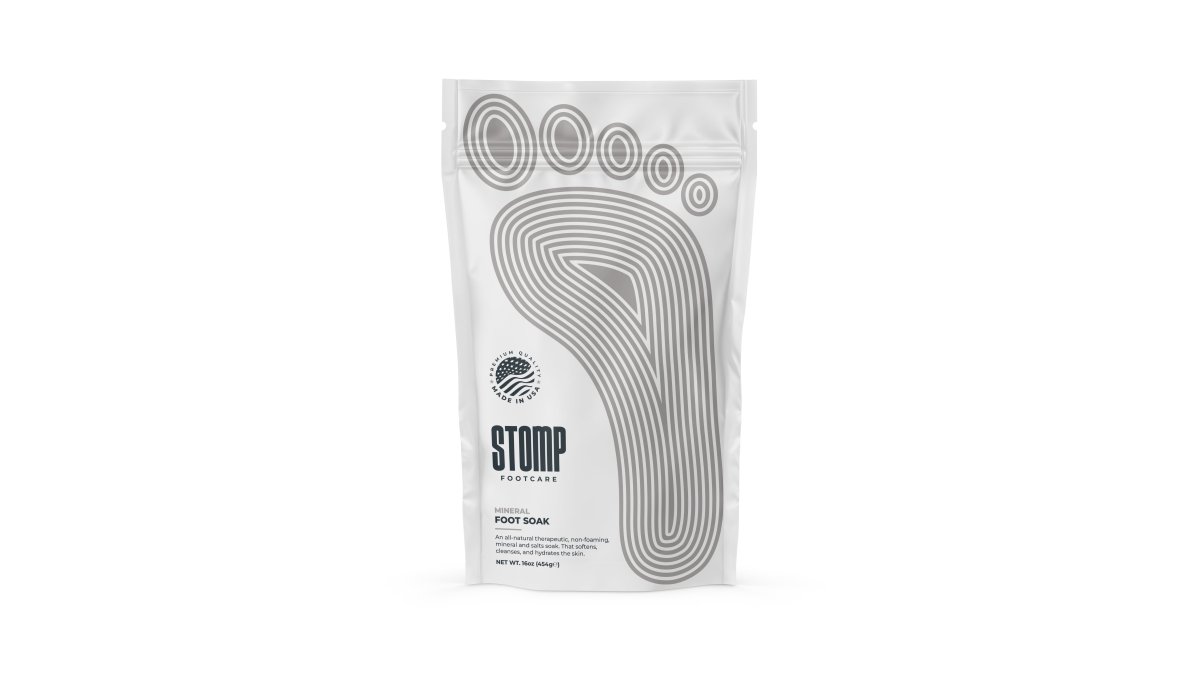
Stomp Footcare's Mineral Foot Soak combines sea salt, peppermint, eucalyptus, and tea tree oil, and it's designed to prepare skin for the treatments that follow. The Revitalizing Foot Scrub handles step two with earth pumice granules and aloe vera.
Building a Natural Foot Care Routine That Sticks
Most foot care guides hand you a product list and stop, they don't give you a routine you can run on a normal week. A natural foot care routine only works if it survives a busy Tuesday, so aim for a five-minute nightly version you'll repeat, not a fifteen-minute ritual you'll abandon by week two.
The Step-by-Step Nightly Foot Care Routine
Run this in order. The sequence matters because each step prepares the skin for the next.
- Cleanse (30 seconds). Wash feet with a gentle cleanser or a quick shower rinse. Pat dry but leave skin slightly damp, damp skin absorbs moisturizer better.
- Treat nails (1 minute). Apply a nail and cuticle oil to each nail and massage it into the cuticle. Nails and skin have different needs, so this is a separate step, not something a foot cream covers.
- Moisturize (1-2 minutes). Massage a urea-based cream into heels, the balls of your feet, and any dry patches. Work it in until it's absorbed rather than leaving a film.
- Seal (30 seconds). For very dry or cracked heels, follow with a thicker occlusive balm or another thin layer of cream, then pull on a clean cotton sock. The sock holds moisture against the skin overnight, when the barrier rebuilds.
- Repeat nightly. Consistency beats intensity: a short daily pass outperforms a long weekly treatment because the moisture barrier rebuilds continuously.
The Weekly Add-Ons
Layer these onto the nightly base rather than replacing it:
- Soak once a week. Ten to fifteen minutes in warm water with a mineral soak softens the outer layer so the next steps work better.
- Exfoliate every second soak. Use a pumice-based scrub with light circular pressure. Skipping this step is the most common mistake, since cream over dead skin never reaches the living layer beneath.
- Treat thick nails as needed. For hard-to-trim nails, a urea-and-lactic-acid softener used a few nights in a row makes trimming easier and less painful.
Why This Order Works
Each step removes an obstacle for the next: cleansing clears the surface, damp skin accepts humectants, exfoliation strips the dead layer so moisturizer can penetrate, and the occlusive plus sock trap water in place. Reverse the order and you're sealing in dead skin instead of treating what's underneath.
Stomp Footcare's Mineral Foot Soak combines sea salt, peppermint, eucalyptus, and tea tree oil to prepare skin for the treatments that follow, while the Revitalizing Foot Scrub handles exfoliation with earth pumice granules and aloe vera. For nails, the Nail Softener uses urea, lactic acid, and allantoin as a nightly treatment, and the Nail & Cuticle Oil, built on safflower, jojoba, and coconut oils, handles dry cuticles in seconds.

Cost Per Ounce: What Cruelty Free Foot Care Really Costs
Cost per ounce is where cruelty-free foot care either justifies its price or doesn't. Certification adds administrative cost but doesn't automatically mean a higher price per milliliter.
Stomp Footcare's creams run 100ml for $9.99 to $11.99, or roughly $2.95 to $3.55 per ounce. The Mineral Foot Soak, at 454g for $14.99, works out to about $0.94 per ounce, making it the lowest cost-per-use item in the line. The Nail & Cuticle Oil and Nail Softener are the highest per-ounce at $14.99 for 29.6ml, which is normal for treatment products applied in drops rather than handfuls.
The practical takeaway: buy the large-format soak and scrub for frequent use, and treat the concentrated nail products as occasional purchases. That mix keeps a full routine under a dollar a week for most people.
Sustainability Beyond Cruelty-Free Certification
Sustainability beyond cruelty-free certification covers packaging, sourcing, and manufacturing footprint, the angle most brands skip. Cruelty-free tells you about animal testing; it says nothing about what happens to the tube after you finish it.
Three questions worth asking any brand:
- Is the packaging recyclable, refillable, or neither?
- Are plant-based emollients sourced with any traceability?
- Is manufacturing domestic or shipped from overseas?
Stomp Footcare's products are made in the USA, shortening the supply chain compared with imports, a meaningful difference for buyers evaluating total footprint rather than one label.
Choosing cruelty-free foot care comes down to verification and consistency: confirm the certification through a third-party database, then build a routine simple enough to keep. Stomp Footcare makes that easy with PETA-certified, USA-made products spanning hydration, callus care, and nail treatment, all priced between $9.99 and $14.99. Start with the Hydrating Foot Cream for daily maintenance and the Intensive Callus Remover for rough patches, then add the Mineral Foot Soak for weekly recovery. Shop now and give your feet the routine they've earned.
Frequently Asked Questions
Which foot cream is not tested on animals?
Stomp Footcare holds PETA certification, which means none of its foot creams, scrubs, or soaks are tested on animals at any stage of production. The full line, including the Hydrating Foot Cream and Intensive Callus Remover, is made in the USA and carries that certification. When shopping elsewhere, look for a named certifying body on the label rather than a generic bunny icon, since some brands use unverified in-house claims.
Is there a cruelty-free urea foot cream available?
Yes. Stomp Footcare's Hydrating Foot Cream ($9.99) contains urea alongside jojoba oil, aloe vera, and vitamin B5, and it is PETA-certified. Urea draws water into dry skin and softens thickened areas, which is why it appears in so many products aimed at cracked heels. The Intensive Callus Remover ($9.99) pairs urea with salicylic acid for tougher, callused patches. Both are one-time purchases with no subscription required.
How can I verify if a foot care brand is truly cruelty-free?
Check whether the brand names a third-party certifier such as PETA or Leaping Bunny on its packaging or website, then confirm that certification directly with the certifier's own directory. A brand that only says 'cruelty-free' without naming who verified it is making an unverified claim. For wholesale buyers, ask for the certification documentation in writing before stocking a product line, since you may need to show it to your own customers.
Is cruelty-free the same as vegan in foot care products?
No, and the two are often confused. Cruelty-free means no animal testing occurred. Vegan means the formula contains no animal-derived ingredients, such as beeswax, lanolin, or honey. A product can be cruelty-free but not vegan, or vegan but tested on animals in some markets. If both matter to you, look for a label that states each claim separately rather than assuming one implies the other.
What ingredients should I look for in natural, cruelty-free foot care?
For dry, cracked heels, look for humectants like urea and glycerin that pull water into the skin, plus occlusives such as shea butter or cocoa butter that slow moisture loss. Keratolytic agents like salicylic acid and glycolic acid help break down thickened, callused skin. Plant-based emollients such as jojoba oil and aloe vera soften without a heavy feel. Fragrance-free and paraben-free formulas are the safer choice if your skin is sensitive or prone to irritation.
